#4 - Assumptio
Irrigada como o coração cheio de sangue”
Daniel Faria, Do livro segundo da noite escura de São João da Cruz 1 (2000)
English version below
PT
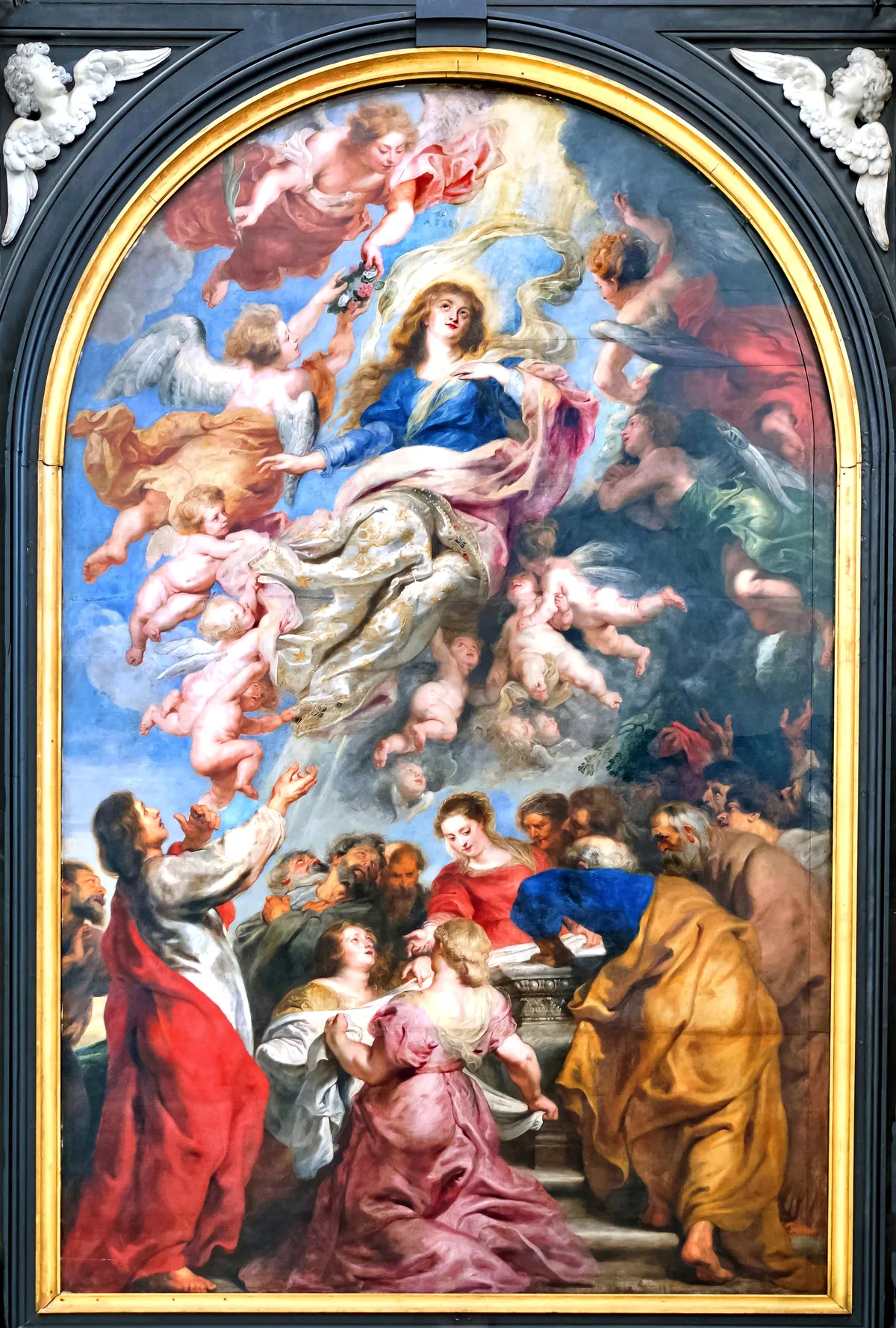
Já quase uma hora passou e os meus olhos ainda não abandonam a sua mão, os seus dedos estendidos, pousados no lugar do coração no peito. Permaneço sentado na primeira fila do altar central da catedral Onze Lieve Vrouw da Antuérpia. Um segundo turista consegue sorrateiramente incluir a minha imagem nas suas fotografias. Sei o estranha que é a minha imagem, mas não posso largar o olhar daquela mão. Quando lhe mudaram a posição do mindinho?
Jurava que sempre o tinha visto arqueado, mas deparo-me agora com ele estendido como todos os outros dedos. É como se a minha professora de violoncelo tivesse cruzado décadas para corrigi-la como corrigia a minha mão no arco com uma vergastada certeira. Só uma violência assim, mínima mas absoluta, poderia fazer sentido, pois algo naquele dedo produz agora uma distãncia insuportável entre mim e a Assunção da Virgem Maria de Rubens, quebrando o sortilégio que até agora me identificava com a sua imagem... a nossa imagem.
Não sei quando este quadro primeiro entrou na minha vida. Sei que o estudei cuidadosamente para uma tese de mestrado que inadvertidamente me pôs do lado dos poussinistes (gostaria de dizer “nunca mais!” mas eis-me ainda com pretensões académicas). Lembro-me também do nosso primeiro encontro em pessoa, quando visitava a cidade ainda desertificada pelo então já encerrado primeiro confinamento do COVID. Mas não me fio destas cronologias e da sua organização. Qualquer encontro que possa vir a ser o primeiro já continha um reconhecimento; sempre a reencontrei desde o início.
Até hoje, o que na imagem mais me fascinava eram dois triângulos imperfeitamente espelhando-se, cada um na sua metade do quadro:
Acima e apontando para cima, inscrito na virgem, um triãngulo formado pela mão do braço direito estendido, o cotovelo dobrado do braço esquerdo e a glabela – o espaço entre os dois olhos. No centro deste triângulo, onde essa agora adulterada mão descansa, o peito motor, ponto de guindaste que a arranca para o céu. Quantas vezes terei copiado essa pose sem saber que a copiava: criança deitada na cama voando, olhos absortos nesse acima do além que todas as religiões nos roubam? Este triângulo é o primeiro, antes mesmo de qualquer imagem, uma pose pessoal atesourando uma sensação, protegendo-a do simbólico com o seu próprio signo. Não a terei encontrado pela primeira vez em Rubens, e não terá sido Rubens o primeiro a encontrá-la.
Abaixo e para baixo apontando, um triângulo (mais isósceles que o anterior) formado por três cabeças femininas. As suas mãos e olhos enfocados na brancura luminosa da mortalha esvaziada. Nenhuma das três parece observar mais do que essa ausência, apesar de estarem rodeadas de apóstolos fascinados pelo turbilhão angélico com que o salvador recuperava a sua mãe. Detenho-me por um momento no jogo de luz: os apóstolos iluminados pela Virgem, e as mulheres (duas delas suas irmãs) iluminadas pelo reflexo do tecido que teimam em agarrar. Este triângulo sempre foi uma parte da imaginação, algo menos meu que o triãngulo que aprendi a inscrever no meu corpo.
Penso em Warburg, para quem o campo artístico não era mais do que uma superfície várias vezes em si dobrada e atravessada por imagens que a usavam como modo de transporte. A imagem, a forma, sobrevive sempre para lá dos objectos que a preservam, pois haverá sempre outros objectos, outros corpos, onde encontrará uma morada renovada. Também eu dou morada a esta imagem de uma morte perfeita que me atravessa.
Talvez a morte me tenha ensinado esta imagem como também a terá ensinado a Rubens. Todas as minhas mortes – as dos que eu amei e ainda amo – sempre tiveram como elemento a ausência do corpo. Nunca pude ver o que restou da nobreza do meu primeiro gato ou da pequenez apertada da minha bisavó; sei apenas onde me disseram que os enterraram. Sempre que alguém que eu amo morria, o seu corpo era-me vedado, interrompendo o meu luto, deixando-me perdido entre a angústia feminina da ausência absoluta e a ilusão masculina da presença total. Por isso mesmo creio nunca ter podido imaginar a minha morte sem que ela me tivesse como espectador.
Antes de Rubens, no entanto, havia Tom Sawyer, o Pirata, com os seus dois compinchas, Joe e Huck, numa galeria abandonada da pequena igreja local, debruçados sobre o espectáculo do seu próprio funeral. Mark Twain não nos descreve o altar, se teriam colocado grinaldas à volta das imagens dos três rapazes, se poriam três baús vazios, se seriam de tamanha adulto, se os fechariam, se as dobras de uma mortalha branca transbordariam o baú de Tom para capturar o sol daquele sábado. Como qualquer romancista, Twain só se permite tocar o mito com uma certa crueldade irónica. Por isso mesmo terá levado os três rapazes a interromper a cerimónia e terá posto na boca de Tom a declaração daquele momento (o funeral ou a sua interrupção, não sei dizer) como seu maior orgulho. Lembro-me de ler esse texto antes de ter visto Maria, mas já naquela altura sabia que os meus olhos não estariam virados para baixo. Queria uma morte jovem para poder, na minha subida acima do além, no meu peito, guardar a certeza do amor e tristeza que deixaria em todos os meus amigos e família. Todos eles ainda vivos para que eu pudesse observar a minha morte na sua mágoa.
É esta imagem que ainda busco sentado perante o altar, mas que já não encontro. Aquele dedo traz à memória a crueldade mesquinha com que os vivos se entre-arranham. A imagem nunca se salva do corpo inscrito que tenta substituir. Já não é esta a minha morte, já não será ela o meu tesouro.
EN
Almost an hour has passed and still my eyes will not abandon her hand, its extended fingers lightly resting on the heart’s place. I remain seated in the first row of the central altar of Antwerp’s Onze Lieve Vrouw cathedral. A second tourist has managed to steal my bizarre image for his photos. I should stop but I cannot let my gaze go off that hand. When did they alter the pinkie finger?
I swear that I had always seen it slightly arched, but now I find it completely outstretched like all the other fingers. It is as though my cello teacher had crossed decades (or maybe centuries depending on the direction) to correct the hand as she would correct my grip on the bow with a well-aimed lash. Only such a violence, minor but absolute, would make sense. For now that finger produces an unbearable distance between Rubens’ Assumption of the Virgin Mary and I, breaking the spell that bound me to her image… our image.
I’m not sure when exactly this painting first entered my life. I know that I studied its details for an MA thesis which inadvertently led me to side with the poussinistes (I would like to scream “never again!” but here I find myself once again overcome by academic pretensions). I also remember our first in-person confrontation, when I first visited the city still deserted by the then recently concluded first COVID confinement. But I do not trust these chronologies and their order. Any memory I recognize as a first is always already that: a recognition. The beginning will always feel as a return.
Until this moment, what most fascinated me in the image were its two imperfectly mirrored triangles, each in its own half of the painting:
Above and pointing upwards, inscribed in the Virgin’s body, a triangle forms between the hand of the extended right arm, the folded elbow of the left and her glabella – the space between the eyes. At the centre of this triangle, where the now adulterated hand rests, the heart, both engine and anchor pulling her above and beyond the frame. I copied that pose so many times without knowing I was copying it: a floating child lying in bed, eyes absorbed by that above beyond all religions steal from us to turn into charity. This triangle is primary, first before any image, a personal posture, treasuring a sensation, protecting it from the symbolic with its own sign. Certainly I did not find it in Rubens first, and certainly Rubens wasn’t the first to find it.
Downwards pointing and below, a second triangle (more isosceles than the previous) is formed by three feminine heads. Their hands and eyes are fully focused on the luminous white of an emptied shroud. None of the three seem to observe anything other than this absence, though they are surrounded by apostles fascinated by the angelic whirlpool returning to the saviour his mother. I stay a while in the play of light: the men illuminated by the Virgin, the women (two of them her sisters) illuminated by the light’s reflection on the shroud. This triangle has always been a part of the imagination, less my own than the triangle I learned to inscribe in my body.
I think of Aby Warburg for whom the field of the arts was but a surface, folded over many times, pierced by images using it as a means of transportation. The image, the form, always survived the objects that preserved it, for there would always be other objects, other bodies to take as their renewed abodes. So too I am inhabited by the piercing image of a perfect death.
Maybe I learnt this image from death the same way she must have taught it to Rubens. All my deaths – of those I loved and still love – had the body’s absence as an element. I was never allowed to see what remained of my first cat’s nobility, or of my great-grandmother’s tightened smallness; I only know where I was told they were buried. Each and every time someone died, their body was barred from me, interrupting my mourning, leaving me stuck between the female anguish of absolute absence and the male illusion of total presence. For this very reason, I believe, I could never imagine my own death without me being there to witness it.
But before Rubens, I now remember, there was Tom Sawyer, the Pirate, with his two mates, Joe and Huck, hidden in an abandoned gallery of the local parish, hunched over the spectacle of their own funeral. Mark Twain doesn’t describe the altar to us, if they had crowned the images of the boys with garlands, if they would place three empty coffins, if these would be adult-sized, if they would be closed, if the folds of a white shroud would spill from Tom’s casket to capture that Saturday’s sunlight. Twain, as any novelist, only allows himself to touch the mythic with the precise cruelty of irony. This is why he made the boys interrupt the ceremony, and why he placed in Tom’s mouth the declaration of that moment (the funeral or the interruption, I cannot say) as his greatest pride. I remember reading this text far before I faced Mary, but already at the time I knew my eyes would not be pointing downwards. I wanted a young death so that I could, in my assumption, in my chest, hold the certainty of the love and sorrow I left behind in my friends and family. I wanted all of them alive so that I could witness my own death in their sadness.
This is the image I seek, seated before the altar, but can no longer find. That finger poisons the memory with the marks of the petty cruelties left on the bodies of the living. The image will never save itself from the inscribed body it tries to replace. This is no longer my death, nor is she my treasure any longer.